
Mawlana Abdolhamid in Zahedan Friday Prayers:
Islamic Countries Must Put Aside “Differences” and Take a “Unified Stance” on Gaza
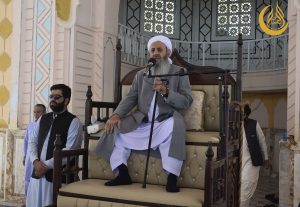
On July 25th , 2025, during the Friday prayers in Zahedan, Shaikh-ul-Islam Mawlana Abdolhamid strongly condemned the atrocities committed by Israel against the people of Gaza and criticized the silence of international organizations. He called on the Muslim Ummah to take meaningful action to end the oppression against the Palestinian people. He also addressed the water, electricity, and economic crises in Iran, emphasizing the need for genuine dialogue with the people, and identified a return to God and to the people as the only way forward for the country.
The Atrocities Happening Today in Gaza Surpass Even Those of the World Wars/ Israel’s enmity with children and women reflects ignorance and cruelty
According to the official website of the Sunni Friday Prayer Leader of Zahedan, Mawlana Abdolhamid began his sermon saying:
“It is everyone’s duty to prevent oppression, abuse, and aggression. One of the gravest injustices—so severe it’s hard to even witness—is what is being inflicted on the people of Gaza. What calamity has befallen them, and what kind of an enemy has overpowered them? One that has no sense—only hatred and hostility, but no humanity.
This is among the most severe forms of oppression: people are killed while standing in food distribution lines. At times, a hundred people have been killed while lining up for food. Where else in the world have you heard of such crimes? Did such crimes even occur in World War I or II?”
He continued:
“Israel considers even children and women to be enemies. When told to go after those who fight them, they respond: ‘All Palestinians are our enemies.’ They consider even children, women, and the unarmed to be criminals.
This is a huge problem. The situation in Gaza is extremely sensitive, and this condition makes it a heavy responsibility for everyone. Anyone with a sense of humanity or faith bears a serious obligation.”
The Friday Prayer Leader of Zahedan said:
“It is astonishing that international bodies who claim to defend human rights remain silent. Why don’t they raise their voices? Why don’t they challenge Israel? Why doesn’t the UN challenge Israel?
The so-called ‘powerful’ countries of the East and West—and all the regional and Islamic nations—have failed Gaza. We all need to repent. And everyone must help Gaza to the best of their ability.”
He added:
“If Islamic governments today had adopted a unified stance, at least on political matters related to Gaza, they would have achieved results. Israel would have been forced to respond.
International bodies and major governments would’ve been compelled to answer, because these governments depend on the region and Islamic countries for their interests. If they sense their interests are at risk, they will take any measure to protect them.”
Gaza’s Plight Deepens the Moral Responsibility of Believers and Free-Spirited
Mawlana Abdolhamid stressed:
“Muslim governments and nations carry a heavy burden, but they haven’t fulfilled their duty as they should. Today, injustice is being done to the Palestinian people—openly, right before the eyes of the whole world. Everyone sees how this nation is being crushed.”
He said:
“All oppressors and merciless rulers of the world must take heed from the consequences of the brutal crimes committed in Gaza. Help must be provided to the people of Gaza in any possible way. It is shocking to hear that over a thousand trucks carrying humanitarian aid are stuck at the Rafah border and are not being allowed to enter.”
Statements Are Good—but Not Enough
Referring to the statement issued by Al-Azhar, Mawlana Abdolhamid said:
“The statement released by Al-Azhar is commendable and conveys the truth. But where are the Egyptians themselves and the Egyptian government? They are neighbors, and Rafah is under their control. Yet they don’t open the Rafah crossing out of fear of Israeli bombardment. People are dying of hunger—open Rafah and the other gates.”
He added:
“The statement is good—but statements and fatwas alone will not solve the problem. There must be action to save the people of Palestine. Fatwas and statements have influence, but we need practical steps. Scholars, leaders, and Al-Azhar must propose actionable solutions.
The highest form of power is not ‘governments’—the highest power is the people. If a nation rises and moves forward, no government can stop it.
The people of Egypt and other nations have a grave duty—especially those countries that border Palestine. They bear an even greater responsibility.
May Allah grant us all the ability to provide solutions, take practical action, and find mechanisms through which people can act.”
Dear People Should Help Gaza in Any Way Possible
Protests in Support of Gaza in Islamic Countries Would Be Politically Deterrent
Addressing worshippers, Mawlana Abdolhamid said:
“One of the things you can do is collect aid for the people of Gaza. The Mohsinin Charity Foundation has previously distributed food there. This foundation also plans to install desalination systems to provide drinking water for Palestinians. So, dear people, help the people of Palestine in whatever way you can and through any organization or means you know of.”
He continued:
“One of the politically effective means of deterrence is organizing demonstrations and protests in Islamic countries.”
He added:
“Various global media—and even an American doctor—have stated that at least 100 people die from hunger daily in Palestine. This is extremely tragic. We believe that regional governments, especially Islamic governments, must put their differences aside—at least for now—and collectively seek solutions to save Gaza and the people of Palestine.”
France’s Two-State Proposal Is a “Brave Move”; The World Should Support It
Mawlana Abdolhamid said:
“The proposal by France to recognize the State of Palestine and to implement a two-state solution—Israel and Palestine—is a courageous initiative. If someone proposes a fair and just solution, then all Islamic and non-Islamic governments—and all people with a sense of humanity—must support it.
If such a plan receives widespread support and a unified stance, this issue can be resolved. Israel’s oppression must be stopped.”
The Water and Electricity Crisis May Lead the Country to a Complete Shutdown
In another part of his sermon, Mawlana Abdolhamid addressed internal issues in Iran. He pointed to the country’s water crisis, saying:
“A very concerning situation has arisen in our country. Famine, lack of rainfall, and the drying of dams have created a severe water shortage. In many cities, water is being rationed—and if it doesn’t rain, even this plan won’t be enough.
Dust storms and power outages have made the situation worse. When there is neither water nor electricity, the entire economy grinds to a halt.”
He continued:
“The country’s economy was already in crisis and ailing. Now, if there is no water or power, everything will shut down, many perishable goods will spoil, and production will cease. Governance cannot function like this, and the country is now facing very serious challenges.
Moreover, the threat of war still looms.”
Dialogue Without the Release of Political Prisoners Is Meaningless
Mawlana Abdolhamid further stated:
“Even the President has recently acknowledged the prevailing disorder and has called for national dialogue—something that conscientious voices have long advocated. The path to resolving the country’s crises does not lie in silencing dissent or imprisoning critics. It lies in meaningful dialogue. Those with differing political views should not be incarcerated; rather, their constructive perspectives should be heard and considered.”
Executions and Imprisonment of Opponents Are Against Sharia and International Law
The Friday Prayer Leader of Zahedan continued:
“It has been stated repeatedly that if true dialogue is to take place, political prisoners must be released. Those under house arrest—many of whom have grown old and frail—should also be freed. Dialogue under the shadow of incarceration and repression is devoid of meaning. The detention of ideological and political dissidents is unjustifiable. The execution of political opponents stands in contradiction to Islamic law, social norms, and international regulations.”
He concluded:
“Those who have something to say – Those who speak of justice and fairness- must be released from prison and engaged in open dialogue. If the President’s remarks are sincere and backed by the state’s leadership, then political prisoners should be freed, and open discussions must be initiated with them and other intellectuals and experts across the nation.”
God and the Nation Are Dissatisfied with the Current State of the Country
Mawlana Abdolhamid said:
“I can say with certainty that both God and the people are dissatisfied with the current situation. The only path to saving the country is to return to Allah Almighty, acknowledge past mistakes, and seek to make amends.
We must examine where we strayed from the Book of God and the Sunnah of the Prophet Muhammad (peace be upon him), where steps were taken against the interests of the people, and where their demands were ignored.
Therefore, the salvation of all of us lies in returning to God and the nation. After the power of Allah, the Creator and Owner of all things, the greatest power among creation is the power of the people.”
He addressed the officials, saying:
“Sit down with religious scholars and examine where injustices have been committed and what mistakes have occurred. Human beings make errors. If the pleasure of God and the approval of the people are obtained, then we can say we have succeeded.
But if we do not gain God’s and the people’s satisfaction, how can we endure any affliction or calamity? When God and the people are displeased, then tribulations will descend from the heavens and rise from the earth—and they will deepen our suffering.
Both the people and the officials should reflect on their actions, correct them, and establish a proper relationship with God through the prophets, especially the Prophet Muhammad (peace be upon him).”
The People’s Demands Must Be Heard—Not Suppressed
The Friday Imam of Zahedan continued:
“When people voice demands, it is because they are facing real problems—and those demands must be heard. People have lost all their life savings. The country has regressed by many years. We must all be concerned for this country, for the territorial integrity of Iran, for its security, and for national unity.”
He added:
“The conflicts and divisions that have arisen in the country have harmed security and unity—and this is a critical issue that must be taken seriously.
If someone voices a demand, they should not be punished. Those in prison for expressing their concerns or offering criticism—listen to them. Don’t extend their sentences. They, too, are part of the Iranian people.”
If the Iranian People Are Moving in One Direction, the Authorities Must Follow
Mawlana Abdolhamid said:
“If the Iranian people are moving in a particular direction, everyone must move with them. The people do not err. When the people express demands, you must listen—observe what they’re asking for, what direction they’re moving in, and what opinions they hold.”
He concluded with a warning:
“Our country is heading in the direction of Gaza’s conditions. When there is no water or electricity and life is disrupted, the weaker segments of society will suffer greatly—and some may even lose their lives.
This demands urgent solutions.”