
Shaikh-ul-Islam Mawlana Abdolhamid during the Friday Prayer in Zahedan:
“The Implementation of JUSTICE, Must be the Foremost Concern of All Governments.”
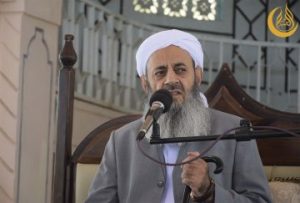
On Friday, July 11th , 2025, Shaikh-ul-Islam Mawlana Abdolhamid, in his Friday sermon delivered in Zahedan, emphasized that justice must be the highest priority for governments. He identified the implementation of justice and heeding the voice of the people as the most effective means of establishing security and overcoming societal crises and challenges.
“Faith” and “Avoidance of Oppression” Are the Cornerstones of Security
According to the official website of the Sunni Friday Imam of Zahedan, Mawlana Abdolhamid, referencing the Qur’anic verse:
“Those who believe and do not mix their faith with injustice—they will have security, and they are rightly guided.” (Al-An‘am: 82),
stated that faith and refraining from oppression constitute the fundamental prerequisites for both individual and collective security.
He elaborated:
“The Almighty clearly declares that those who possess faith and do not contaminate it with injustice shall enjoy security. This verse indicates that true security—both in this world and the hereafter—belongs to those who believe and refrain from wrongdoing.”
He continued:
“Faith and conviction, along with piety and avoidance of injustice, are the two principal foundations of peace and security in this world. One who observes piety and does not commit injustice will not become a target of retaliation or vengeance and will remain safe. However, should a believer engage in injustice, sin, or encroach upon the rights of God or His creation, their security shall diminish accordingly.”
He emphasized that both individuals and governments are addressed by this verse:
“Whosoever avoids injustice and the usurpation of rights shall be granted security.”
Enduring Security Depends on Justice and Respect for Citizens’ Rights
Mawlana Abdolhamid further remarked:
“The supreme concern of every government should be the establishment of justice. It is incumbent upon national and international leaders to prioritize justice and the restoration of rights, as justice is the guarantor of peace in both this life and the hereafter. When authorities contemplate justice, they are, in fact, contemplating security.”
He added:
“Enduring and stable security in any nation is attainable only through the implementation of justice, respect for the rights of citizens, safeguarding freedoms of speech and expression, and giving due attention to the grievances of the populace. When people cry out against injustice, their voices must be heard.”
He warned:
“Security enforced through policing and the use of force is inherently temporary. True and lasting security is established through justice, equality, and the observance of the rights of all individuals—including detainees, prisoners, women, ethnic communities, religious groups, and society as a whole.”
From an Islamic Perspective, All Are Equal Before Justice
A Government Is Islamic Only When Justice Is Fully Realized
Mawlana Abdolhamid declared:
“Those held in prisons and detention centers have rights. According to Islamic principles, no one has the right to strike even a single blow against a detainee. Authentic Islam is embodied in the life of the Prophet Muhammad (peace be upon him), the Rightly Guided Caliphs, and Sayyiduna Ali (may Allah be pleased with him).”
He stressed:
“All individuals are equal before justice. In Islam and the Qur’an, a ruler is no different from a common citizen, a president is equal to a laborer, and a governor to a watchman in the eyes of justice. When a Jewish man lodged a complaint against Sayyiduna Ali (may Allah be pleased with him)—the Commander of the Faithful—before Judge Shurayh, the judge, appointed by Ali himself, ruled in favor of the Jew due to insufficient evidence from Ali. Though we narrate such historical incidents in our sermons, why do we not embody them in practice?”
He concluded:
“Whether we speak of an ‘Islamic Republic,’ an ‘Islamic Government,’ or use any other designation attributed to God and His Messenger, such a government can only truly be called Islamic when justice and truth are upheld in their entirety.”
“The Remedy for All Problems and Crises Lies in a Return to Justice and Listening to the People”
In continuation of his sermon, Shaikh-ul-Islam Mawlana Abdolhamid emphasized the fundamental necessity of administering justice, stating:
“The enormous expenditures currently allocated for ensuring security should be redirected toward the realization of justice. The establishment of justice is simple and does not require extravagant spending. If justice is implemented, crimes such as theft will vanish naturally.
Prior to the advent of Islam, the land of Hejaz was steeped in insecurity and people’s property was constantly looted. However, following the emergence of Islam, security was established in society in a manner that was both profound and unprecedented.”
He further remarked:
“If the divine injunctions, the Holy Qur’an, and the noble Sunnah of the Prophet Muhammad (PBUH (are effectively enforced, genuine security will be achieved. There will then be no need for expansive ministries, massive security budgets, or constant police patrols on streets and highways.”
“Allow me to be clear,” he urged, “the solution to all societal challenges and crises is a return to justice, fairness, and a willingness to sit with the people and heed their voices.
We speak as those who are devoted to the well-being of our nation. We care deeply about the territorial integrity, security, unity, dignity, prosperity, and welfare of the people. We affirm that the path to achieving all these aspirations lies in upholding justice, returning to the people, and safeguarding national interests.
We must focus on serving the Iranian nation, and ensure that the country’s resources are spent for the benefit of its own people.”
“Let Us Neutralize the Enemy’s Opportunities through Negotiation and Dialogue”
Mawlana Abdolhamid also advocated for the continuation of diplomatic dialogue, stating:
“It is my considered recommendation that, through negotiation and the peaceful resolution of issues via dialogue, we deprive the enemy of any opportunity to generate new challenges for the country.”
He added:
“We must strive to bring matters to a conclusion through diplomatic means, while also attending to the urgent needs of the people, who are currently enduring extraordinarily difficult conditions.”
“The Deportation of Afghan Nationals Must Be Gradual and Humane / Drivers Must Not Exploit Them with Excessive Fares”
In the concluding segment of his sermon, the Friday Imam of Zahedan addressed the recent deportation of Afghan nationals from Iran, stating:
“Over the years, Afghan migrants have been received in our country with kindness and generosity. Now that they are being repatriated, I urge that this process be conducted in such a way that they do not return home with resentment. Just as our welcome was gracious, our farewell must also reflect goodwill.
If the farewell is harsh, it will undo all the compassion and goodwill extended in the past.”
He continued:
“My recommendation to national and provincial authorities is to allow Afghan migrants sufficient time to sell their belongings and to ensure that the deportation process is conducted gradually and with dignity. Afghanistan has been plagued by war and insecurity for nearly five decades and may not be in a position to receive large waves of returning migrants at once.”
He further advised:
“I appeal to the public—particularly bus and transport drivers—not to exploit these vulnerable individuals by charging them exorbitant fares. Either transport them free of charge or request only a minimal fare. Demanding excessive payments from them constitutes an unethical exploitation of their circumstances.”
“I Extend My Gratitude to the People of the Province for Their Support of Migrants”
“The Al-Ghadir Camp in Zahedan Is Severely Overcrowded; Provincial Authorities Must Intervene”
Mawlana Abdolhamid expressed his appreciation to the people of Sistan and Baluchestan for their compassion toward Afghan migrants, stating:
“I feel compelled to thank the noble people of the province for the kindness you have shown to Afghan migrants by providing them with food, water, and other necessities. Popular volunteer groups have been formed in this regard, and the Mohsenin Charity Foundation has been especially active.”
He also highlighted the dire conditions at Al-Ghadir Camp in Zahedan:
“My recommendation to provincial authorities is to deploy additional personnel to organize and manage affairs at the Al-Ghadir Camp. The camp was designed to accommodate 3,000 individuals, but on occasion it receives as many as 10,000.”
He added:
“The space and facilities at Al-Ghadir are extremely limited. Provincial authorities should prepare additional locations for this purpose to ensure that migrants are repatriated with dignity, security, and compassion.
Beyond our borders, many people are interviewing these migrants about their experiences in Iran. It would be a grave reflection on our nation and our people if these individuals—our fellow human beings and brothers and sisters in faith—were to leave our country with bitterness and dissatisfaction.”