
Mawlana Abdol-Hamid in the Friday sermon:
The Economy Has Been Left to its Own Fate / Ethnic and Sectarian Government in Iran Can’t be Successful / The Pursuit of the Rights of the Martyrs and Wounded will Continue
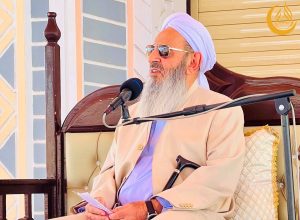
Shaikh-ul-Islam Mawlana Abdol-Hamid, the Friday prayer leader of the Sunnis of Zahedan, in the Friday sermon of October 2, 2026, strongly criticized the ignoring of the economy and public demands, and emphasized the need to change the country’s major policies and move toward a system that is above ethnicity and sect. On the anniversary of the “Bloody Friday” tragedy, he made clear that the pursuit of the rights of the families of the martyrs and the wounded will continue until a result is achieved.
The economy has been left to its own fate; no one is there to listen to the people
According to a report of the official website of Mawlana Abdol-Hamid, mentioning the severe financial and economic hardship of society, he said: Nowadays everyone is in financial and economic hardship and most families cannot meet their expenses. Workers, employees, and even traders and businesspeople are under pressure. Rates change daily, inflation has been rising, and the value of the currency is being lost; this is disrupting economic stability, life, and the market.
Criticizing the lack of proper management, he said: These are serious problems, and it is not known when measures will be taken to solve them and when these crises will be remedied. The solution to these problems was prudence, planning, and strong management, but unfortunately the economy has been left to its own fate, there is no rein or control over it, and for this reason the pressure has multiplied. On the other hand, sanctions have become very extensive and the country is under economic siege. People are in pain; they are distressed, and no one listens to them. They do not see a bright future for themselves, their children, and their country, and these conditions are very hard.
People have the right to participate in the fate of the country; you should have paid attention to internal affairs
The Friday prayer leader of Zahedan, emphasizing the fundamental rights of the nation, and said: People have the right to participate in and speak about their own and their country’s fate. The country belongs to the Iranian people. Over this long period, the people’s words should have been heard and their voice should have been listened to; if the people’s words had been heard, matters would not have reached this point.
He further said: We pray to Allah Almighty to open a door of light for this country. Those who have responsibility have a very heavy and sensitive duty and must take care of the people and the country. We are in conditions where, instead of thinking about others, we should have thought about our own nation and our own country.
Anniversary of Zahedan’s “Bloody Friday”; we will not give up our legal and recognized rights
In another part of his speech, referring to the anniversary of the tragic incident of September 30 (Bloody Friday of Zahedan), he said: These days coincide with the anniversary of September 30, 2022, which was a very bitter and painful incident. People had come to the Musalla only for prayers and there was no provocation that could be considered a threat or that anyone should be subjected to insult and humiliation, but unfortunately such oppression occurred that shook the divine throne.
Mawlana Abdol-Hamid, expressing deep sympathy with the families of the martyrs, said: A large number of those offering prayers were martyred and many were wounded. This tragedy was very heavy for the Iranian nation and especially for the people of Sistan and Baluchestan, and every freedom-minded human being who received this news was affected. When the bodies were handed over to the families, only God knows what they went through. We pray for the families of the martyrs and wounded of this incident and for all the oppressed martyrs of Iran, and we share in the grief and sorrow of all Iranians.
Emphasizing the continuation of the demand for justice, he made it clear: The Iranian nation did not expect such a behavior from the authorities and the government. If anyone has capability and responsibility, they should think about remedying these griefs and sufferings; otherwise, we have entrusted everything to God Almighty. However, this does not mean that we do not demand our rights. We believe that rights must be demanded. We do not give up our own and the people’s legal, legitimate, and recognized rights and we do not forgive anyone. The pursuit of the rights of the families of the martyrs and the wounded is ongoing, and we will not back down until the damages inflicted are remedied.
An ethnic and religious government in Iran cannot succeed; old policies must be changed
The Friday prayer leader of the Sunnis of Zahedan, pointing to the true meaning of republic, reminded the authorities: The owners of this country are all the Iranian people, and the country does not belong to any one person or specific group. Just as at the beginning of the revolution, the people voted for the system of the Islamic Republic by their own will and not by force, in the future too the people should be asked and their opinion should be sought; the very meaning of republic is that the opinion and view of the public should be made the criterion.
Criticizing personal and sectarian attitudes in the country’s administration, he said: If the government had been run on the basis of Islam and attention had been paid to the freedoms and justice of the era of the Holy Prophet, peace be upon him, and the rightly guided caliphs, I am certain that if 98 percent of the people voted that day, today 100 percent would vote. But unfortunately you adopted a personal and sectarian manner, and religious thinking cannot meet people’s demands and needs. Preferring personal opinion results in the dissatisfaction of others. If you had set aside your own taste and adopted broad-mindedness, many of today’s problems would not have arisen.
Mawlana Abdol-Hamid emphasized: We have repeatedly said that in a country like Iran, where there is an abundance of ethnic groups, sectarian communities, tendencies and viewpoints, a government attributed to a particular ethnicity and sect cannot succeed. A system must be implemented that is above ethnicity and sect, encompasses all issues, and establishes equal justice for all (justice among women and men, ethnicities, and religions and sects). We advise out of goodwill and sympathy that those old policies that did not work should be abandoned and not repeated. A new approach should be devised that is suited to the current conditions.
Do not attribute individuals’ weaknesses to Islam
The president of Darululoom Zahedan, expressing regret over some people becoming suspicious of Islam in Iran, reminded: Today you hear that many people in Iran have become suspicious of Islam, although these weaknesses are not in Islam; these weaknesses belong to individuals, and individuals’ weaknesses should not be counted against Islam. Islam is the religion of justice and fairness. If we study the life of the Noble Prophet, peace be upon him, and the rightly guided caliphs, we will see in that era justice and freedom were practically implemented and this was not merely a theory. I request the Iranian nation not to abandon God and religion and to follow the right path.
Security is a need of all segments of society
At the end of his speech, Mawlana Abdol-Hamid, emphasizing the province’s security, especially its preservation in border areas, said: As I advised last week, attention should be paid to the province’s security so that no challenge arises. Security is a necessary issue and is in the interest of all people, and all segments and classes need it. We were already concerned that the increase in kidnapping and theft spreads various kinds of unrest and puts the province in difficulty. Everyone’s security should be maintained so that no one feels danger; all segments can live in the shadow of peace, and brotherhood remains established.