
Mawlana Abdolhamid:
We Hope That the “Apology of the Provincial Security Council Members” to the Families of the Martyrs and the Wounded of Bloody Friday Will Bring Comfort to the People
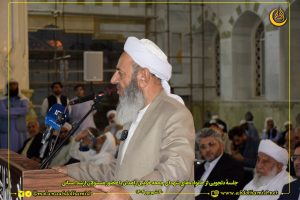
Shaikh-ul-Islam Mawlana Abdolhamid, in a gathering held on Sunday evening (30 Shahrivar 1404 / September 21, 2025) at the Grand Makki Mosque of Zahedan with the presence of senior provincial officials — convened to console the families of the martyrs and the wounded of Zahedan’s Bloody Friday — stated that the people and the families of the martyrs and the injured were, from the very beginning, “thirsty for dignity” rather than “thirsty for wealth.” He expressed hope that the “apology of the members of the Provincial Security Council” would bring solace to the hearts of the people and these families.
The Patience of the People and the Families of the Martyrs Revealed the Reality of the September 30th Incident to Everyone, Which Is a “Very Great Achievement
According to the office of the Sunni Friday Imam of Zahedan, Mawlana Abdolhamid, after welcoming the guests of the gathering and praying for the elevation of the martyrs’ ranks and the recovery of the wounded, said:
“The events of September 30th, were a very grave tragedy. From the very outset, our entire concern was that the province’s security should not be disturbed and that fratricide would not begin. For this purpose, we sent messages and strove to ensure that everyone maintained security in the province until the matter could be investigated and the truth clarified.”
He added:
“The families of the martyrs, though most afflicted, exercised patience, and this patience bore fruit. The truth became clear to everyone — both officials and the general public — that in this incident innocent people were killed and injured. The unveiling of this truth is itself a very great achievement.”
At That Time, Provincial Officials Proposed the “Payment of Blood Money,” but the Families of the Martyrs Replied: We Are Not “Thirsty for Wealth,” We Are “Thirsty for Dignity”
Mawlana Abdolhamid continued:
“After the incident, some officials — who no longer hold positions in the province — were told that in order to resolve the matter they must proceed through proper means and local customs. They proposed the payment of blood money to the families of the martyrs and the wounded, but the families replied: We are not thirsty for wealth or money; we thirst for dignity. If the actions of the officers who committed this crime are condemned and if apologies are made to us, and if the perpetrators are dealt with, then we desire no money.”
He added:
“Although the families of the martyrs and the wounded were given more than the legally prescribed blood money, land grants, and the victims of this tragedy were declared ‘martyrs,’ these are all commendable. But what truly matters is honoring and respecting the people and apologizing to them. This has always been the principal demand of the people and the families of the martyrs.”
This Gathering Has Been Held to “Apologize” to the Families of the Martyrs and the Wounded
The Friday Imam of Zahedan went on to explain the purpose of the gathering, saying:
“The members of the Provincial Security Council have come here today precisely for this purpose: to apologize to you — the bereaved people and the families of the martyrs who have been afflicted by the loss of their loved ones — and to denounce what happened.”
He added:
“Previously, there had also been some moves from Tehran to resolve this issue, but since they were perhaps unfamiliar with the culture of this region, they could not address the matter in accordance with local customs. Therefore, observing the local and Baluchi traditions of this region can provide consolation to the other side. In the history and culture of this region it has always been customary that whoever commits an error or crime must apologize. I have said before as well: if we ourselves had committed such a mistake, not once but a hundred times, we would have gone to apologize and to seek forgiveness.”
The “Forgiveness and Magnanimity” of the People of Sistan-Baluchestan Is Exemplary and Rare Throughout the Country
Mawlana Abdolhamid described “forgiveness and magnanimity” as among the most prominent qualities of the people of the province and said:
“Forgiveness, magnanimity, and resolving disputes through customary and local methods in Sistan-Baluchestan are exemplary and rare across the country.”
He further noted:
“The fact that the Governor — as the representative of the government, vested with the authority of the state — and the honorable members of the Provincial Security Council have come to this gathering and apologized to the families of the martyrs, is itself an act of honor-giving. We hope this will bring comfort to the families of the martyrs of the Zahedan and Khash tragedies.”
For Us, the “Competence and Capability” of Individuals Is What Matters in Assigning Responsibilities
In another part of his speech at this gathering, the Friday Imam of Zahedan emphasized the principle of meritocracy in the delegation of responsibilities, saying:
“For us, there is no difference between locals and non-locals; what matters to us is service. If a local official cannot serve the people, then, in our view, he is not a priority.”
He added:
“If a local individual possesses competence, he is preferred over a competent non-local. But if the local individual lacks the necessary qualifications, then the one who is capable and competent is the rightful choice.”
We Think About the “Dignity of the Iranian Nation” and the “Security of the Country”
Mawlana Abdolhamid then turned to national issues, saying:
“We think about the dignity of Iran, the unity and honor of the Iranian nation, and the security and territorial integrity of the country. We hope that security will prevail in our country, that no new ‘wars’ or ‘sanctions’ will be imposed upon it. We also hope for the creation of an atmosphere of dialogue and attentive listening to the people’s voices — this will be a source of mercy.”
We Want No Fratricide in the Province, and We Want the Province’s Security Preserved
The Friday Imam of Zahedan further stated:
“We want there to be no fratricide or bloodshed in the province, and for the security of its cities, villages, and roads to be maintained.”
He stressed:
“I personally have no belief in violence, killing, or assaulting people. In my entire life, I have never uttered even half a word pointing toward the killing of a human being; rather, to the extent possible, I have prevented killings from taking place.”
“Pursuing the People’s Demands” and “Implementing Justice” Are the Best Ways to Ensure Security and Foster Unity
The Friday Imam of Zahedan then highlighted the role of listening to the people’s demands in ensuring security:
“I believe that the people’s demands and needs must be pursued. If they are not, this will not contribute to security. The best way to ensure security is for the people’s demands to be addressed.”
He added:
“I also believe that demands must not be pursued through violence and war, but rather through civil means — this is the best path.”
Mawlana Abdolhamid emphasized:
“Nothing can bring security, peace, solidarity, and national cohesion to society more than listening to the people and implementing justice and fairness.”
Scholars, Community Leaders, and Members of Parliament Should Convey the People’s Voices to Officials
In conclusion, Mawlana Abdolhamid said:
“My constant advice has been that scholars, community leaders, councils, members of parliament, and all those in positions of responsibility must convey the needs and demands of those who are unable to raise their voices themselves to the officials. It is mentioned in a hadith that the Prophet Muhammad (peace and blessings be upon him) urged his companions to bring the people’s words and needs to him. In another hadith he said: ‘Intercede for the people, and you will be rewarded.’ Advocate good on their behalf, and you will receive reward.”