
Mawlana Abdol Hamid in Zahedan Friday Prayer Sermons:
A Politically Homogenized Government and Parliament Do Not Yield Results
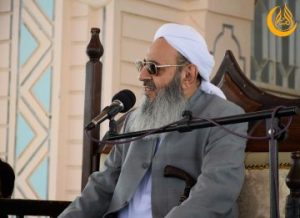
Shaikh-ul Islam Mawlana Abdol Hamid, in his Friday prayers today, June 21st, 2024, declared that everyone has witnessed and experienced firsthand that neither a politically homogenized government nor a one-ideology parliament can adequately serve the nation.
He stated “some individuals, under the misconception that a politically homogenized parliament would lead to less conflict and debate, and better alignment with the government and ruling establishment, are advocating for the creation of such a parliament through stringent selection processes. However, experience has shown worldwide that a parliament composed solely of one faction is ineffective.”
The Friday prayer leader of Zahedan mentioned: “A successful parliament is one that is diverse and pluralistic, representing all thoughts, spectrums, and ethnicities. Parliament, as the name suggests, is a council for consultation and legislation. When proponents and opponents are consulted, and the views, needs, and representatives of different segments of society are presented, the best opinion is chosen, the best law is passed, and it is accepted by all ethnicities, religions, orientations, women and men of society, and the religious and non-religious. The government should also represent all tribes and thoughts, and the cabinet, which is the place for consultation and decision-making, should represent all spectrums. Because the best and most successful government is the one that represents the whole country, and the people’s satisfaction with such a government will be greater.”
Iran Belongs to All Women, Men, Ethnicities, Religions, and Faiths
Emphasizing Iran’s diverse nature, with its unparalleled ethnic, religious, and denominational plurality, he asserted: “Iran belongs to all women and men, all faiths and denominations, all ethnicities, and all ideologies. Indeed, a government that is truly representative and inclusive of all ethnicities and religious groups is more likely to be successful in Iran.”
Shaikh-ul-Islam Mawlana Abdol Hamid added: “When Mohamed Morsi was elected as President of Egypt as an Islamist, I wrote a letter to him and stated in the letter that he should try to follow the gradual path of Islam in Egypt and not be strict. I also said that considering that the Egyptian government has been Western-oriented and society has been subject to it so far, he should try to treat the people with leniency. I recommended that he include religious and secular people from different groups and ethnicities in the government and form an inclusive government so that the enemy cannot take advantage.”
The Political Homogenization Was One of the Biggest Mistakes
He added: “I have always told the officials of the Islamic Republic that one of the biggest mistakes was the policy of homogenization. This idea was put forward by inexperienced people who believed that homogenization should be carried out and people should be screened through various filters and selections so that only those from a specific group would be employed, and all different and diverse thoughts and views were ignored.”
The Sunni Friday prayer leader of Zahedan clarified: “My sincere and compassionate advice is that homogenizing the future parliament and government will not work. Only a government that represents women, ethnic groups, religions, and even faiths will work in Iran. A successful parliament will also be one in which all strata and tendencies are represented. And God Almighty’s law for governing the world is diversity and plurality. I have also said before that the parliament is not a representative of the government and the ruling power, but represents the people, and the people should freely choose their representatives. The president is also the representative of the people.”
A Thorough Reassessment of Past Approaches is Imperative
Shaikh-ul-Islam Mawlana Abdol Hamid further stated: “Islam emphasizes freedom and is very close to democracy. People should be able to choose their own president, as in many free countries. We must reconsider past approaches, take into account all ethnicities and ideologies, involve the nation, and gain its consent.”
Concluding his statement, He emphasized: “The way of the prophets has also been to avoid dwelling on mistakes and to correct them wherever they occur. It is the duty of the government to heed the demands of both supporters and opponents, to ensure the well-being of the nation, to consult with its opponents, and to listen to their voices. There is no higher, better, or more successful ideology or policy than one that gains the approval of God and the people.”
A believer is “farsighted” and does not make the same mistake twice
In the first part of his speech at the Friday prayer ceremony in Zahedan, Shaikh-ul-Islam Mawlana Abdol Hamid enumerated “farsightedness” as one of the prominent characteristics of a believer and said: “One of the characteristics and qualities that come as a blessing of faith is that a believer does not only look at his feet(short-term context or consequences), but also has foresight. Another characteristic of a believer is that he always evaluates himself.
He further added: “It is a sign of a believer’s foresight that he thinks and strives for the development of both this world and the hereafter for himself and others. A believer does not forget the Day of Judgment and his presence in the court of Allah Almighty under any circumstances, and he is always thinking and worried about this matter and is careful not to trespass the rights of Allah and the rights of the people.”
The Friday prayer leader of Zahedan mentioned: “A believer is always wise and vigilant and does not make hasty decisions about matters. Instead, he analyzes and evaluates the issues and makes decisions with thought, consultation, and foresight.”
He added: “Another characteristic of a believer is that does not make the same mistake twice. If he gets hurt by something once, he avoids approaching it forever.
Mawlana Abdol Hamid added: “The prophets (peace be upon them) were farsighted people. A believer should always review and revise his thoughts and policies, and there should always be acceptance in a believer to see what is right and which way is better, and to choose the way that will have a better result.”